Your strategy, traded by agents that show their work.
One agent reads the chart and makes the call. A second sizes the trade in code before any order goes out. Every decision is written down, including every time it waits.
Your first run is free, no card. Every agent starts on a $10,000 paper account.
Watching breakdown-retest short
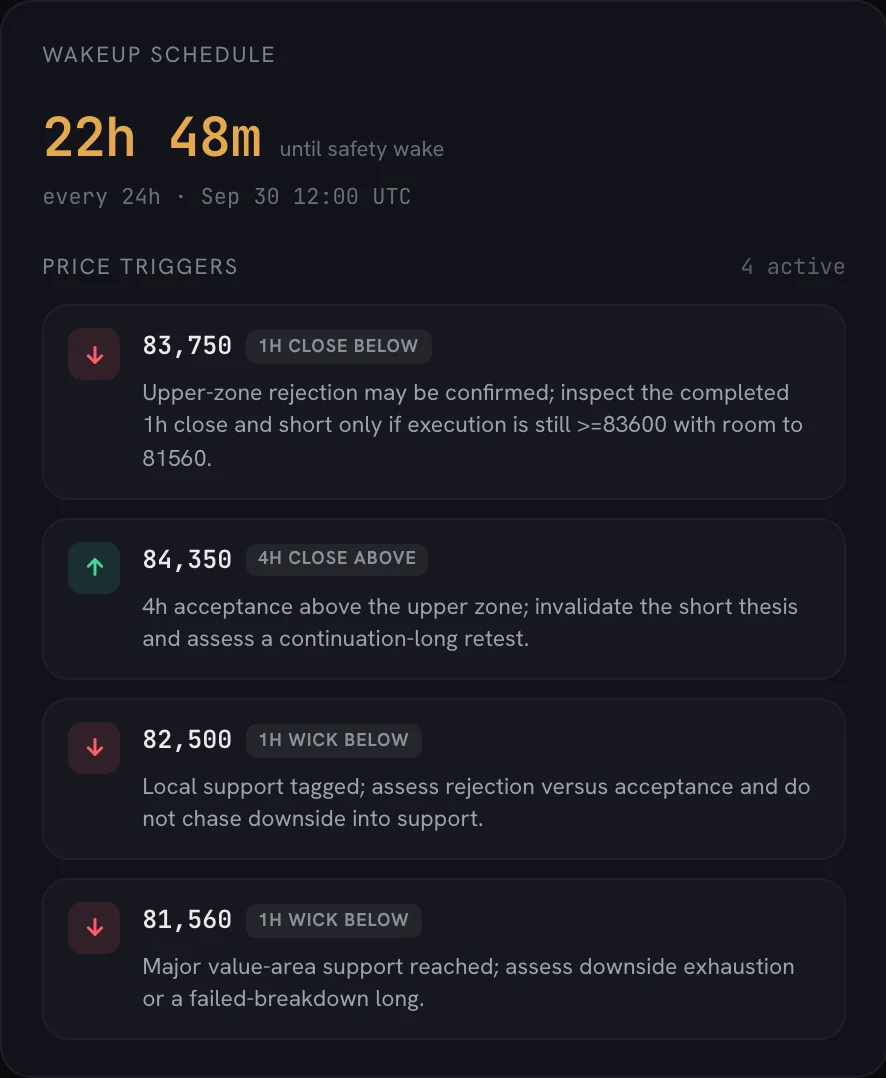
“Upper-zone wick rejected mildly, but the short still needs a 1h close below 83750.”
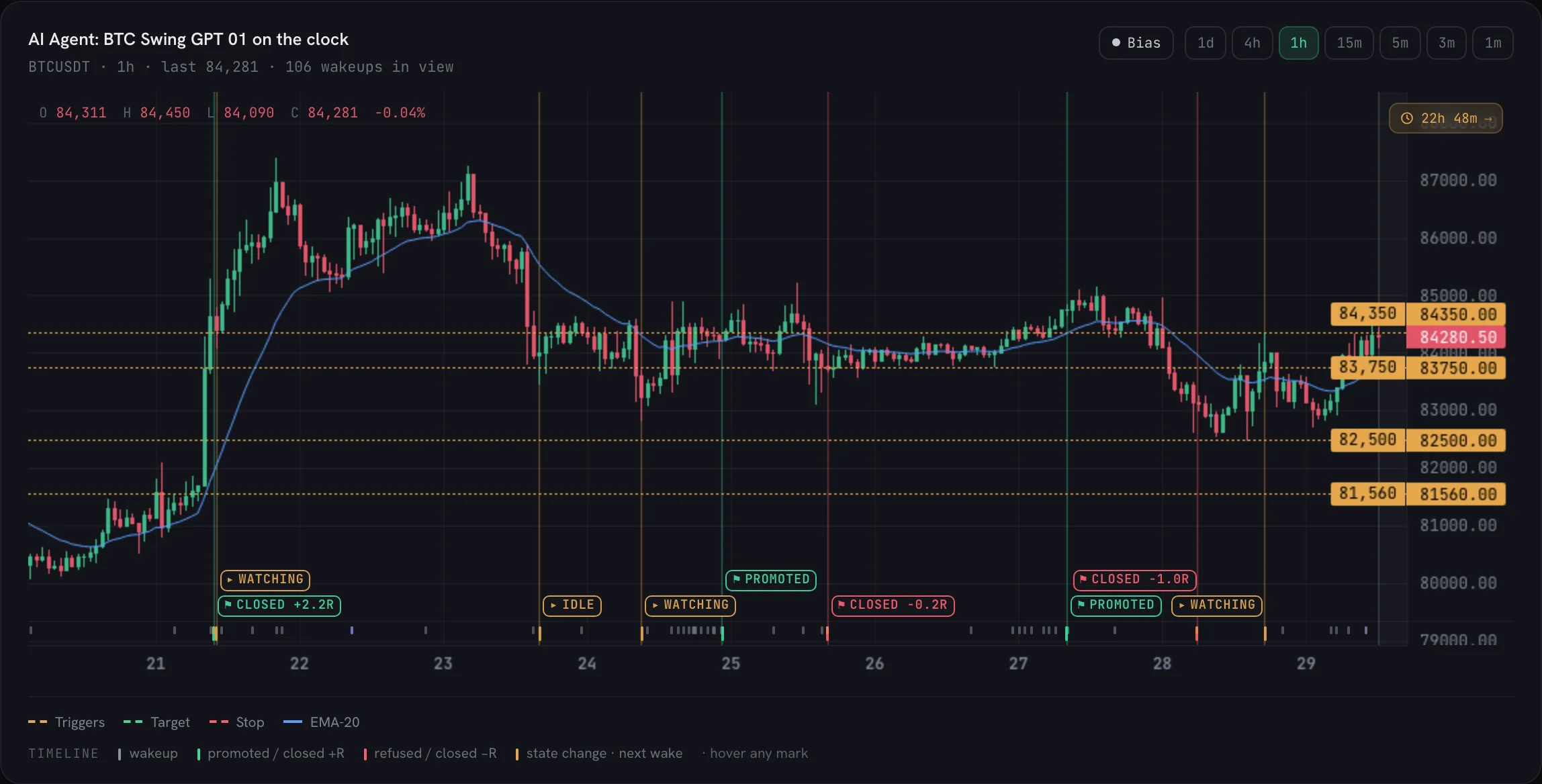
It decides when to look.
Your agent does not run on a timer. At every wakeup it sets price alarms at the levels your setup cares about, and wakes up when one breaks. A daily check covers quiet days.
- A level breaks. The agent wrote down why that level mattered when it set the alarm.
- It reads what your strategy asks for: candles on your timeframes, the volume profile, its open position and its notes from last time.
- It trades, or it waits and says why. Then it sets the next alarms.
Each agent has one job.
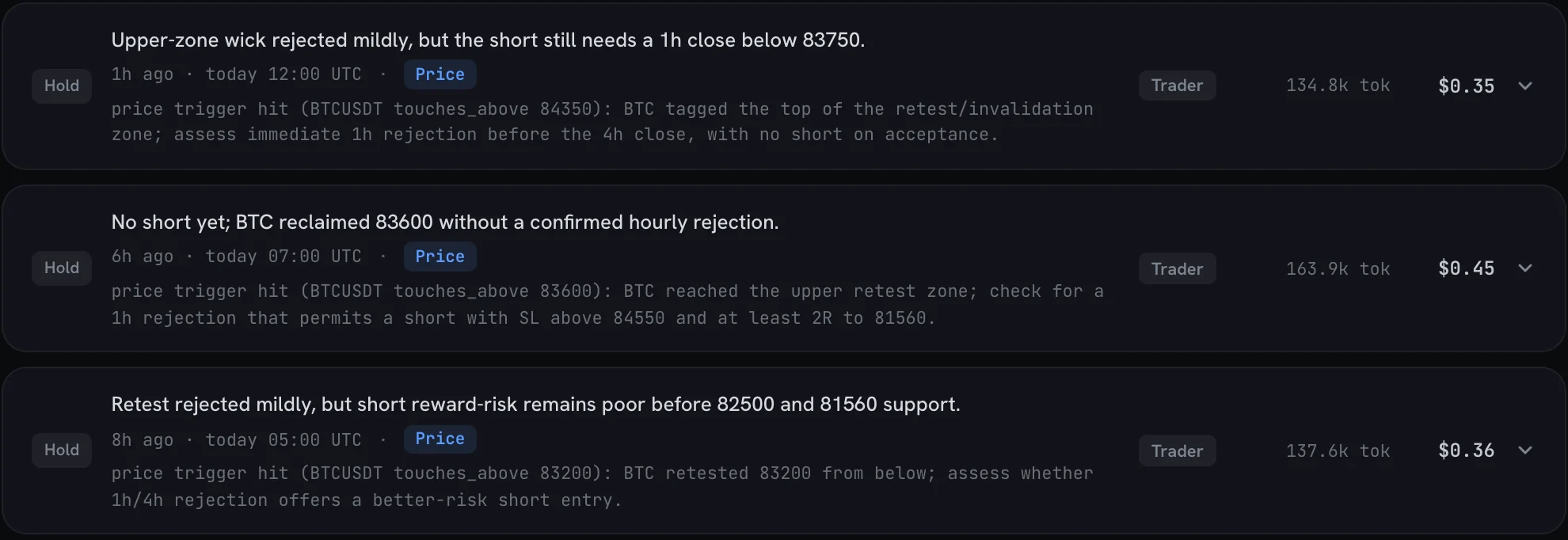
Nobody on a trading desk decides, sizes and grades their own trade. Neither does yours. The quotes are real outputs from our BTC agent.
Trader
Reads the chart, checks your rules, makes the call or waits. It never picks leverage and never trades without a stop.
Upper-zone wick rejected mildly, but the short still needs a 1h close below 83750.29 Sep 2026
Controller
Sizes the trade from your risk limit in code, arms stop and target at the exchange and reads them back. With its veto on, it can turn a trade down.
Opened long … at 84708.9 with …, SL 82750 and TP 89200.27 Sep 2026 · size and leverage left out
Curator
Reviews closed trades against your strategy and keeps a short playbook the trader reads. It never trades.
Breakout-retest long: after a confirmed 4h breakout, refuse to chase vertical extension; arm the retest level and enter when it holds on completed 1h candles.curated 22 Sep 2026
Market Analystoptional
Reads funding, open interest, long/short ratios and fear & greed. Publishes one bias with a target and an invalidation. Your trader only sees it if you switch it on.
DOWN, conviction 4/10, 2 to 5 weeks. Target 80,300, invalid on a daily close above 87,400.29 Sep 2026
Channel Scoutoptional, new
Follow a trader on YouTube. It reads each new video and writes down their plan. You decide whether your agent uses it.
LONG, conviction 8/10, intraday. Target 85,000. Wait for an upside breakout and retest of the 50 EMA, then long if support holds.read from a video, 29 Sep 2026
Each agent runs on the model you pick: GPT-5.6, GPT-6, Claude Opus or Claude Fable.
Set up in five questions.
Pick the setups you trade, or describe your strategy in your own words. It becomes a document you can read and edit, and the agent re-reads it on every run.
Pullback continuation
Buys the dip in a trend.
Breakout retest
Buys the retest of a broken ceiling.
Range fade
Trades the edges of a range.
Exhaustion reversal
Fades a vertical move, after it turns.
You set the rules. Code enforces them.
No stop, no trade. A trade without a stop is rejected before any order.
Size is arithmetic. Your risk limit divided by the stop distance, with liquidation beyond the stop.
Stops live at the exchange. They fire while the agent sleeps, is paused, or is out of credit.
Your funds stay on your exchange. We hold no money. Keys need trading rights only.
Test your key with one real trade. About $6, opened and closed, before your agent trades.
Paper first. Going live is a switch you confirm, and it starts flat.
Where it can go wrong. A disciplined agent will run a bad strategy very consistently. Paper skips fees, slippage and funding, so it looks a little better than live. A model can misread a chart. That is why every decision is written down, and why the stop and the size never depend on the model.
Keys, permissions and risk limits in detail
Keys. A key you paste is encrypted and used only while a run is executing. You decide on the exchange whether it may withdraw; make it without that right. The key test places one small real trade, checks the stop, moves it, takes a partial and closes, then confirms the account is flat. On Binance it also reads the key's permission flags and warns you if it can withdraw; Bitunix does not publish them.
Risk limits. By default code takes your per-trade risk limit, scales it by the agent's confidence, divides by the distance to the stop, and picks leverage that fits your margin ceiling. A stop on the wrong side, no balance, an order below the venue minimum or margin over the ceiling is rejected before anything is executed. An advanced mode hands sizing to the controller agent with only the wrong-side-stop check left in code; it is off unless you turn it on.
When you stop. Pausing stops future runs. An open position keeps its stop and target at the exchange. Archiving or deleting an agent is refused while a position is open.
Pay for the thinking. See every cent.
Every run shows the model it used and what it cost. We earn nothing per trade, whether the answer is a trade or a wait.
- First run
- Free, no card.
- Platform
- $0 a month for founding members, then $39 a month.
- AI credits
- Pay as you go. Every run shows its exact cost.
- Live trading
- Your exchange's fees apply, as without us.
After the free run the agent pauses. To keep it running you put a card on file and use AI credits, in paper mode too.
Billing details
What is free. Creating an agent, reading its strategy and its first run. Describing your strategy to the AI wizard is itself an AI conversation and uses credits; picking setups does not.
Your card. Needed when you keep an agent running after its free run, in paper mode too, because that claims your membership through Stripe. A $0 founding seat does not charge the card for membership. Credit top-ups are separate one-off payments; auto top-up is optional.
Founding price. It lasts as long as the membership stays active.
Empty balance. The agent stops taking new decisions. An open position keeps its stop and target at the exchange.
Cancelling. In the Stripe billing portal, any time. Close or take over live positions first; prepaid credit is non-refundable except where the law requires otherwise. See the Terms.
Why I built it
I wanted an agent that trades like a disciplined person: it waits for its setup, writes down why, takes the stop without arguing, and learns from the trade afterwards. Grid bots can't do that. Language models can, with the right tools and hard limits. So I built those.
Our own agent trades BTC in public, losses included. Build yours and tell me what it should do next.
The founder, Switzerland · [email protected]